
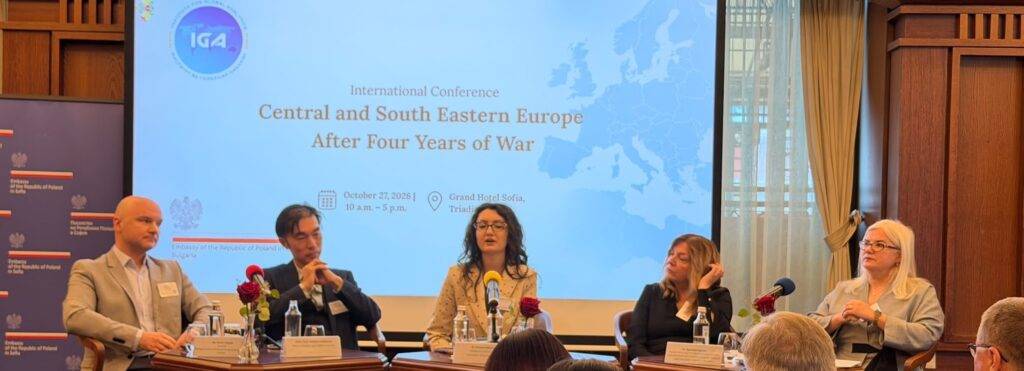
On 27 October 2026, the Institute for Global Analytics, in partnership with the Embassy of the Republic of Poland in Sofia, brought together experts from across Europe to examine how foreign influence, hybrid threats and geopolitical realignments are reshaping Central and South Eastern Europe.
Across the keynote, highlight session and three thematic panels, speakers explored Russia’s evolving influence strategies, China’s role in the region, and the prospects for stronger regional cooperation amid an increasingly uncertain security environment.
Several key takeaways emerged from the discussions:
- Hybrid threats increasingly target social cohesion, not just institutions. Speakers discussed how disinformation, cyberattacks and sabotage can reinforce one another, exploiting existing divisions over migration, national identity, historical grievances and support for Ukraine. Examples included fabricated news stories designed to provoke tensions between Polish and Ukrainian audiences, as well as attempts to undermine trust in democratic institutions.
- Resilience requires a whole-of-society approach. Countering foreign interference means going beyond fact-checking and crisis response. It requires permanent early-warning and analytical capabilities, credible and transparent government communication, media literacy, and cooperation among public institutions, journalists, universities and civil society. Speakers also stressed the importance of protecting democratic pluralism: legitimate policy criticism should not automatically be labelled foreign influence.
- Russia and China have overlapping interests, but distinct strategies. While China has become a crucial supporter of Russia, speakers cautioned against treating Beijing merely as an amplifier of Moscow’s narratives. In parts of the Western Balkans, China offers political elites an alternative source of investment and infrastructure development, creating economic dependencies that can be difficult for future governments to unwind. Russia, meanwhile, continues to exploit local political networks, historical ties and societal cleavages.
- The region’s divergent political choices and dependencies constrain collective action. Differences in threat perceptions, domestic politics and energy dependence continue to shape responses to Russia’s war against Ukraine. Discussions of the Visegrad countries illustrated these divisions, while initiatives such as the Bucharest Nine and the Three Seas Initiative highlighted opportunities for cooperation on security, energy and transport infrastructure.
- Connectivity can strengthen resilience, but can also create new vulnerabilities. From north–south transport links to energy infrastructure and trade corridors, regional connectivity has strategic as well as economic significance. The discussions on the South Caucasus further highlighted how new connections can create incentives for peace while simultaneously generating new dependencies and competition over the rules governing them.
- Resilience also requires a forward-looking perspective. Speakers emphasised the importance of preparing societies for different possible futures, strengthening public preparedness and developing the capacity to respond to emerging threats. In an information environment increasingly shaped by AI-generated content, bots and targeted narratives, public trust and human judgement remain essential.
A central message throughout the conference was that resilience depends on understanding both external strategies and the domestic conditions that enable them. Stronger regional cooperation requires sustained institutional relationships, regular exchanges of expertise and a shared commitment to democratic security, even where national experiences and political priorities differ.
We thank the Embassy of the Republic of Poland in Sofia for co-organising the conference, and all our speakers, moderators and participants for their thoughtful contributions and engaging discussions.
Below you can find interviews our Founder Dr Rumena Filipova gave on the topic of the conference.